
Basic education in thematic contexts
Education is the foundation of individual, social and economic development. Basic Education develops people’s abilities to lead meaningful and productive lives. With its transformative role, Basic Education has the potential to foster sustainable development, civil society participation, and social cohesion. It plays a vital role in addressing thematic issues such as climate change and disaster risk reduction, peace building and gender equality as well digital transformation and migration.

SDC has decided in January 2025 to phase out its thematic engagement in basic education. This decision reflects a strategic prioritization of resources, with increased focus on Education in Emergencies (EiE) and Vocational Skills Development (VSD).
At the same time, SDC remains committed to ensuring a responsible and gradual transition. Ongoing basic education projects will continue to be implemented until the end of their respective phases. For this reason, documentation, tools and knowledge products related to basic education remain available on this platform.
Education is the essential foundation of individual, social and economic development. Basic Education develops people’s abilities to lead meaningful and productive lives. With its transformative role, Basic Education has the potential to foster sustainable development, civil society participation, and social cohesion.
The SDC recognizes basic education as a driver of change and is committed to using it transformative potential in addressing various thematic issue. It promotes basic education as a means of enhancing resilience, in particular in climate change and disaster or health and nutrition practices and using its potential for digital transformation, conflict transformation, to mitigate violence, facilitate dialogue and cohesion including gender equality.
Green education – Education and Climate Change, Disaster Risk Reduction and Environment CDE
Education has a powerful transformative potential to make people care about the environment, support sustainable behavior, mitigate natural disaster and be a lever to reduce climate change. Basic Education is a central vehicle to improve public knowledge on the effects of climate change, impart environmental awareness, advocate responsible agricultural production and drive societal change towards more environmentally sustainable behaviour and consumerism.
In addition, education can improve disaster preparedness and reduce vulnerability to climate-related disasters. When it comes to enhancing resilience to climate change and disasters, children and youth are important agents of change. Learners and teachers needs to be equipped with the proper life skills, transformative capacities and professional competencies to contribute to the green transition.
The SDC is committed to contribute by engaging through its bilateral cooperation and multilateral policy. The primary focus of SDC’s engagement in education will remain on ensuring that all learners achieve foundational skills while simultaneously mainstreaming climate change and green education within the existing portfolio and in the preparation of future interventions.
Education as a key factor of social cohesion, peace building and gender equality
Education, like no other institution, can develop knowledge, values, skills and attitudes that nurture social cohesion and peacebuilding, contribute to promoting the reduction of inequalities as well as fostering civic engagement and better-functioning institutions. In addition, education is a key lever for gender equality.
Citizenship and human rights education, value-based education, education for conflict resolution and a culture of dialogue contribute to tolerance, respect and socio-political participation, as well as support for more inclusive and just public institutions. However, education systems can also be averse to social cohesion through exclusion or by imparting knowledge and value that fuel conflict and discrimination.
The SDC supports education for human rights, gender equality, a culture of peace and non‐violence and global citizenship, both through the education system or through programmes in other sectors. In addition, it promotes the development of decentralised education systems and good governance in the education sector.
The SDC responds to gender issues through targeted measures. It promotes girls and women’s basic education but also addresses concerns specific to boys and men. It addresses women’s economic empowerment, including training in nontraditional trades, literacy and facilitates access to jobs.
Migration
Migrant and displaced children and youth are often the first to be excluded from education systems. Ensuring their inclusion in education is vital for their protection and offers benefits for the countries of origin and destination. Providing access to education while acknowledging these children’s previous education improves their social integration and labor market prospects.
Education empowers these children to reach their full potential, enabling them to make valuable contributions to their host country. Migrants' active involvement in the economy enhances the productivity of host nations, reduces their reliance on aid and social services, and supports smoother integration into local communities.
Additionally, the knowledge and skills gained during migration and displacement are valuable upon return to their home countries. Education systems must be adaptable to the unique needs of migrants and displaced populations.
In line with its «Leave No One Behind» principle, the SDC supports access to quality education for people on the move, implementing programmes that offer migrant and displaced children and youth better prospects for the future. SDC’s holistic approach spans the humanitarian-peace-development nexus, ensuring education is life-saving and provides hope and future opportunities.
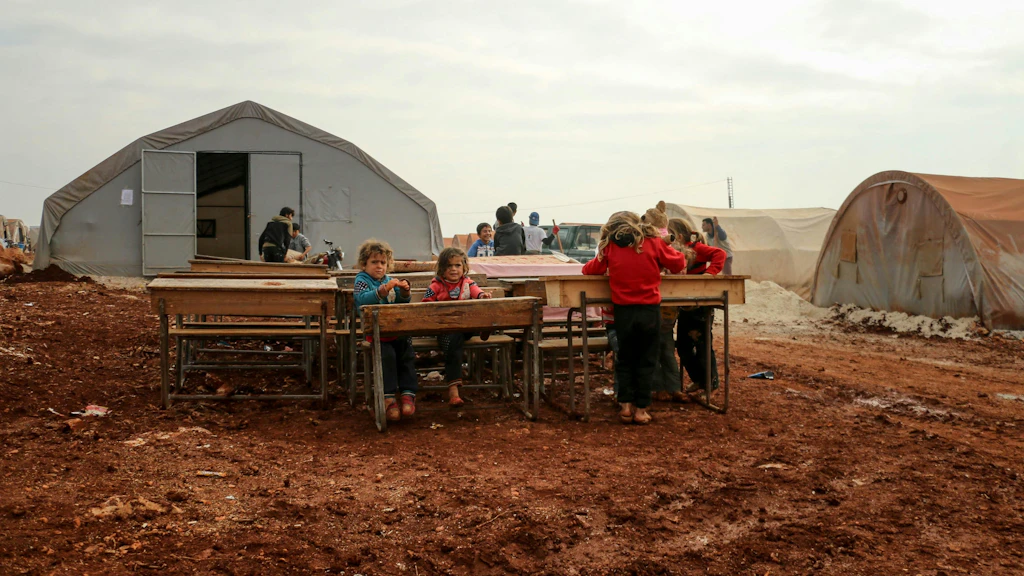
Education in emergencies
Education in emergencies (EiE) programming is a way to ensure the right to education even during crisis.
Education and digital transformation
Information and communication technologies (ICT), if harnessed properly, can be a powerful tool for transforming education and improve access and quality for the most vulnerable populations. ICT can make learning more attractive, relevant, differentiated, engaging, and can help to overcome shortcomings in education systems. It has a potential to strengthen the performance and inclusiveness of education systems and to reinforce education system governance, quality and assessment of learning, or teacher training. However, it can also further inequalities.
SDC believes that technologies are a tool to respond to specific needs and have to be learner-centred. The SDC programmes take into account the changing requirements and skills needed for life and work in a digitalised world; increased digitalisation implies the development of adapted standards, changing teaching practices and instruments.
Key documents
Digitalisation
Designing Effective ICT-Solutions in Education and VET - Guide - SDC
Digitalization and Inclusive Learning - Case Collection - SDC
Information Communication Technologies (ICT) and Education - Summary Note - SDC
Information Communication Technologies (ICT) and Education – Report - SDC
Quality Learning for Inclusion with ICT - TechGuide - SDC
Migration & Human Rights
Climate change
Index
Related topics
CDE Network
SDC Climate, Disaster Risk Reduction & Environment Network
PGE Network
SDC Peace, Governance & Equality Network
Migration Network
SDC Migration and Forced Displacement Network